
BM Interactive Group partnered with Cross Country Home Services to redesign ECM, the call center application agents relied on to support home warranty customers. The legacy Oracle system was slow to learn, painful to use, and unable to keep pace with modern service expectations. We led user research, usability testing, and end-to-end UI design for a ground-up replacement focused on clarity, speed, and scalability.
The work centered on high-stakes renewal and service workflows: contract review, entitlement checks, provider selection, appointment scheduling, and call wrap-up. Early prototype testing showed meaningful gains in call efficiency and agent confidence before development began.
Legacy Oracle tools built for a different era of support.
Call center agents were the front line for Cross Country Home Services, but the tools they used worked against them. Support calls routinely lasted 15 minutes or more. New agents needed roughly 90 days to become productive. The interface was visually exhausting, with harsh color and an unstructured layout that made every call feel harder than it should.
- Average handle time stuck at 15+ minutes on routine renewal and service calls
- 90-day average onboarding for new call center agents
- Eye strain and mental fatigue from outdated color and layout patterns
- Technology that could not scale or integrate with SMS, tracking, and modern e2e support
- Fragmented workflows that forced agents to hunt for context mid-call
Map the renewal flow first. Test before you build.
We started with agent research and task analysis across the ECM Renewal Flow: items, attributes and symptoms, entitlement checks, provider selection, appointment setup, and summary. Wireframes established a consistent page structure, progress model, and information hierarchy so agents always knew where they were in the call.
Usability testing with agents validated the flow before high-fidelity design. Each screen was tuned for scanability: customer context up front, actions grouped by task, and primary paths surfaced without visual noise.
A calm, structured agent workspace built for real calls.
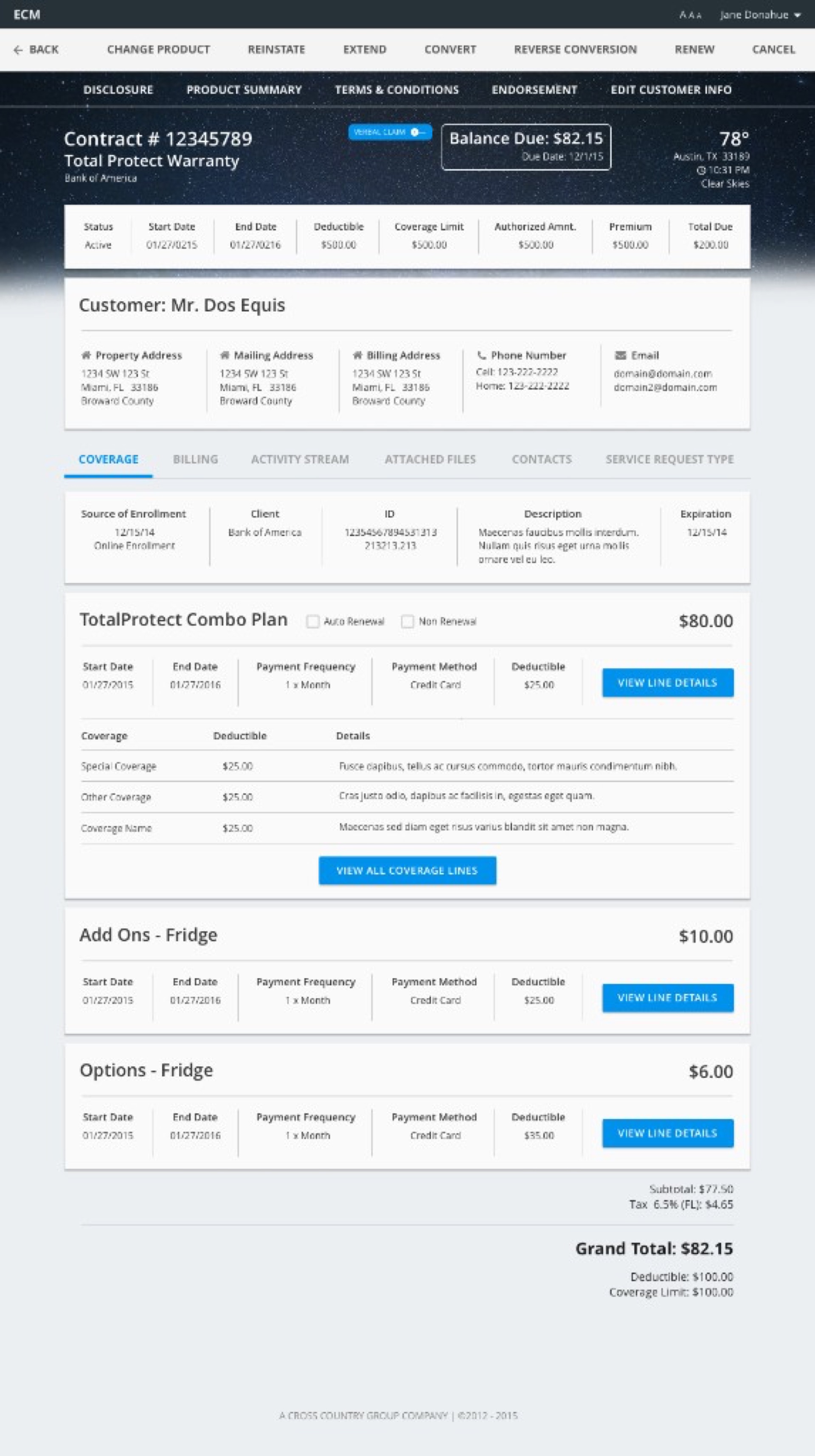
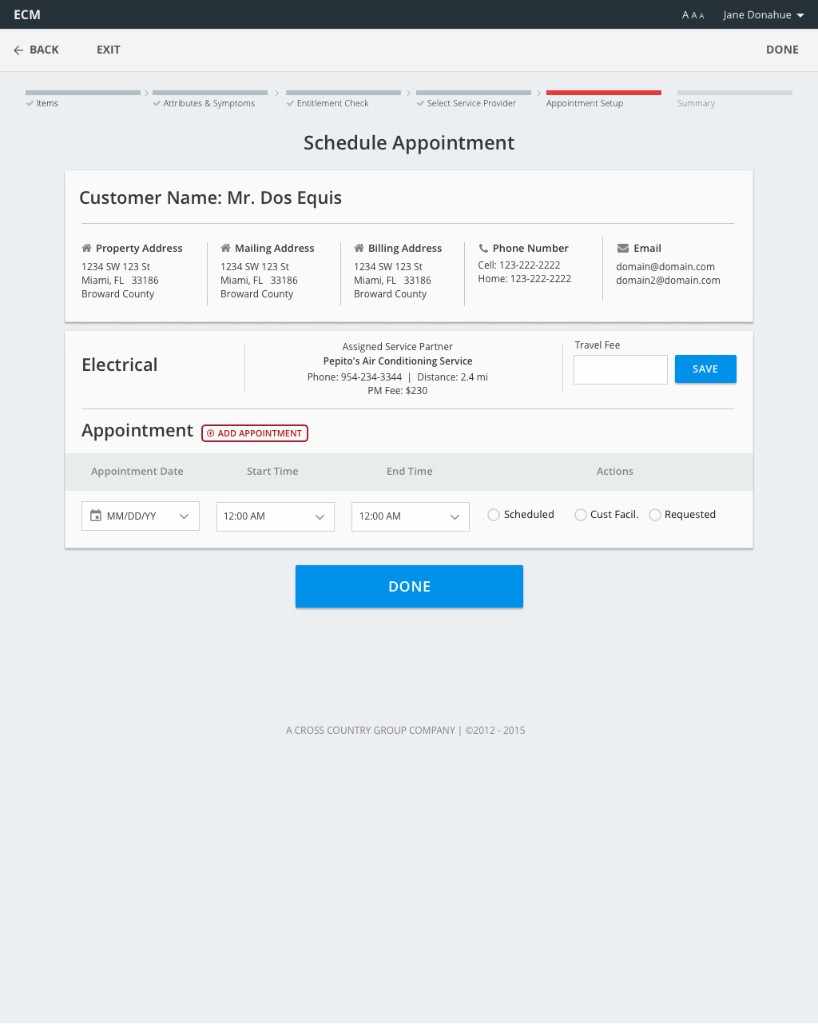
High-fidelity design translated the wireframe system into a production-ready UI: restrained color, clear typographic hierarchy, and task-focused layouts that reduce cognitive load during live customer conversations. Key surfaces include the contract dashboard and appointment scheduling flows agents use during live calls.
Faster calls, shorter ramp, less fatigue.
Early prototype testing showed the new ECM experience could cut average call time from 15 minutes to 8, shorten the learning curve for new agents, and reduce the mental exhaustion agents reported on the legacy Oracle system. The design also established a scalable foundation for SMS, tracking, and richer end-to-end customer support integrations that the old platform could not support.
in early testing
learning curve
agent eye strain
modern integrations